Strategic Priority Balancing Indicator

  • Extended Foster Care (EFC) Engagement

    The Extended Foster Care program offers young adults leaving foster care the opportunity to voluntarily continue receiving services while transitioning to independence. The additional support provided by EFC services has been linked to improved outcomes in adulthood. Former foster youth can choose to enter or leave EFC at any time during their years of eligibility (ages 18-21). DCYF tracks both initiation of EFC and longer-term utilization of services as a balancing indicator for our support of successful youth transitions. While the number of eligible young adults has decreased over the past five years, resulting from smaller numbers of children and youth in out-of-home care more broadly, the percentage of eligible young adults who initiate and utilize EFC services has consistently increased over the same time period.

    Extended Foster Care Engagement among Former Foster Youth (Ages 18-21), State Fiscal Years 2021-2025

      Combination column chart and line graph showing percentages of eligible former foster youth who initiate extended foster care (EFC), utilize it, or do not engage at all with it, and the count of eligible young adults. Across all five years, the utilization rate of EFC is within 2 percentage points of the initiation rate. While the raw eligibility numbers have decreased each year, resulting from fewer children and youth in out-of-home care each year, the percent of eligible former foster youth who initiate and utilize EFC has grown each year, and the percent who do not engage at all with services has decreased each year. In state fiscal year 2025, 96% of the eligible population initiated EFC services, receiving them for one day or more since turning 18, 94% utilized EFC services, receiving them for at least 6 months since turning 18, and only 4% of eligible former foster youth did not engage at all with EFC
     
  • Early Achievers Rated Providers

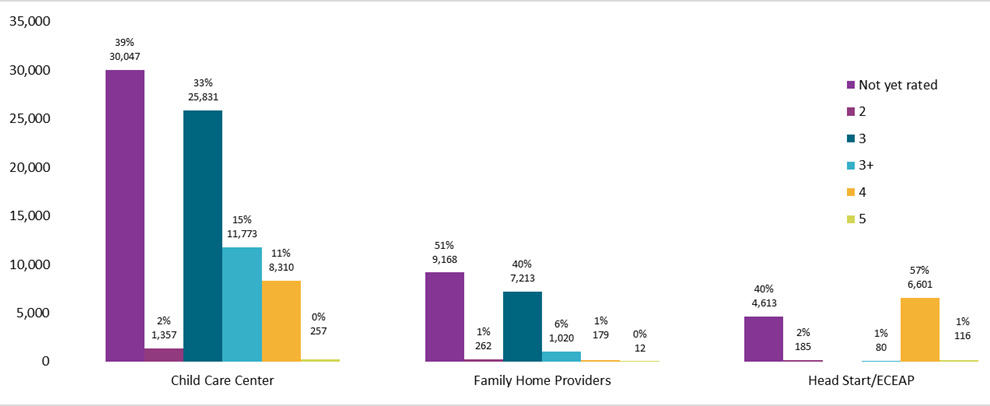
    Early Achievers is an easy-to-understand quality rating system for participating early care providers. DCYF monitors Early Achievers ratings as a balancing indicator for our priority to create a high-quality, integrated B-8 system. 

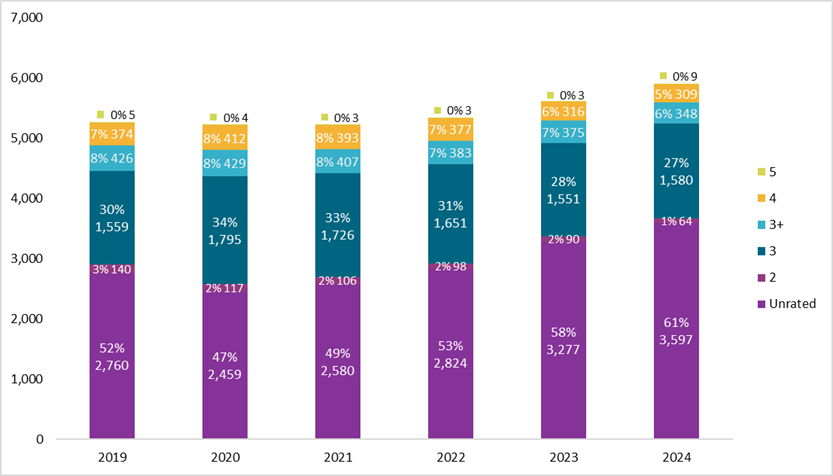
    Number and Percent of Early Achievers Enrolled Providers by Rating, SFY 2019-2025

      Bar chart showing the number and percent of Early Achievers enrolled providers, by rating, state fiscal years 2019-2025. The total number of providers has steadily increased over the past five years. From 2020-2024 the number and percent of unrated providers steadily increased, but in 2025 it came down by 4 percentage points, from 61-57%. Across the years, the proportions of rated providers have changed only a little. Providers rated 2 decreased from 3% in 2019 to 1% in 2025. Providers rated 3 are the largest group, making up 30% of providers in 2019 and 31% in 2025. Providers rated 3+ decreased from 8% in 2019 to 5% in 2025. Providers rated 4 decreased from 7% in 2019 to 5% in 2025. And providers rated 5 increased from less than 0.5% in 2019 to 1% in 2025. In 2024 only 9 providers were rated 5, but in 2025 59 providers were rated 5. Most likely, the increase in providers rated 5 accounts for the decreases in providers rated 3+ and 4.
     
  • High School Graduation of Youth in Foster Care

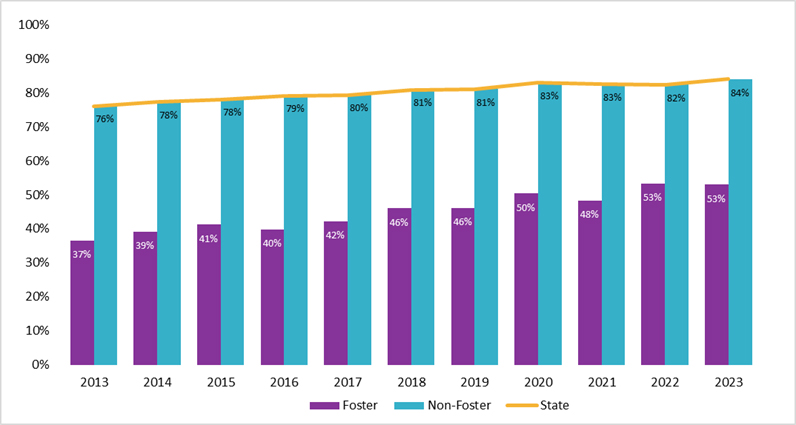
    One of DCYF’s strategic priorities is that we create successful transitions to adulthood for youth and young adults in our care. Graduation from high school is an outcome indicator for this priority. Statewide, the 2023 four year graduating cohort included 85,306 students, 84% of whom graduated on time. In most years, an additional 2-3 percent of the class have graduated by the end of their fifth year. Among that 2023 cohort, 552 youth were indicated as having been in foster care. Youth who have not been in foster care graduated at the rate of the overall class, whereas 53% of youth who had been in foster care graduated on time.

    Four Year Graduation Rate, by Foster Care Status, Classes of 2013-2023

      graph
     
  • Housing Instability

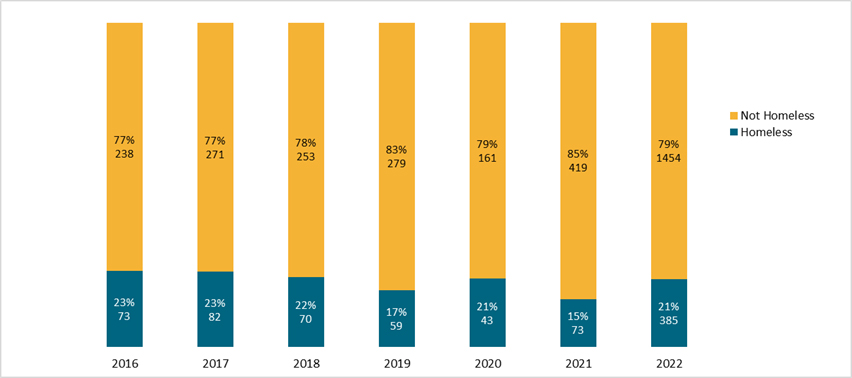
    Housing instability is a balancing indicator for our outcomes related to creating successful transitions to adulthood. Youth and young adults who exit the foster care system without being placed into a permanent family through reunification, adoption, or guardianship are often referred to as "aging out" of foster care. These youth are at higher risk of becoming homeless or unstably housed than those who have a family to support them at this critical life transition. Across the past five years, within 12 months of leaving care, 16% of former foster youth experienced an episode of housing instability or homelessness.

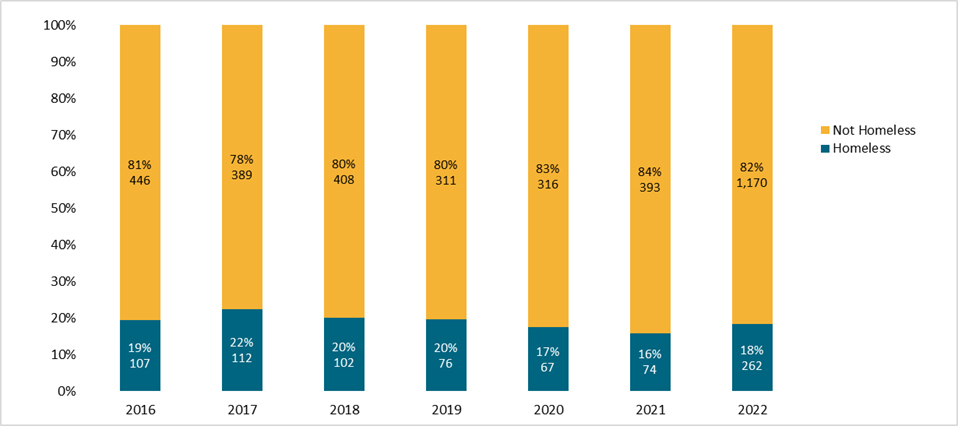
    Analysis has also been done about the housing instability of youth and young adults (ages 12 to 25) who are released from a Juvenile Rehabilitation institution. Until 2021, the rate of homelessness for youth and young adults leaving Juvenile Rehabilitation institutions has largely mirrored those of former foster youth. In the most recent years however, new programs and resources have reduced homelessness among former foster youth, while rates of homelessness among youth and young adults leaving JR have changed very little. Across the past five years, 21% experienced an episode of housing instability or homelessness within 12 months of discharge.

    Homelessness Among Former Foster Youth (Ages 18-24) within 12 Months of Leaving Foster Care, 2018-2022

      Stacked, 100% column chart showing proportions of homelessness among former foster youth, ages 18-24, within 12 months of leaving foster care, for the years 2018-2022. Over the past five years, homelessness rates among former foster youth have declined, most notably beginning in 2021. The proportion experiencing homelessness was 22% in 2018, 19% in both 2019 and 2020, 12% in 2021, and 13% in 2022.

    Homelessness Among Youth and Young Adults (Ages 12-24) within 12 Months of Leaving Juvenile Rehabilitation, 2017-2023

      graph