Racial Equity

  • Equity in Kindergarten Readiness

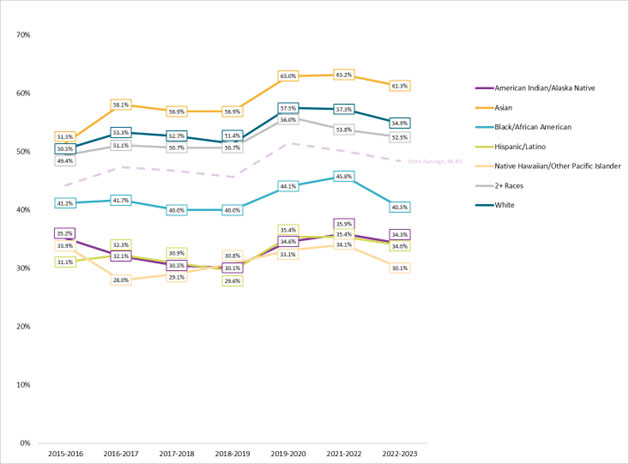
    Although the statewide rate of kindergarten readiness has improved somewhat over the past six years (as measured by the Washington Kindergarten Inventory of Developing Skills assessment), this change has not benefitted all racial/ethnic groups equally. The readiness rates for American Indian/Alaska Native, Hispanic/Latino, and Native Hawaiian/Other Pacific Islander children remain substantially below the rates for children from other groups. Readiness rates for all groups have returned to their pre-COVID levels, but Asian and White children continue to have the highest rates of kindergarten readiness and those rates have increased faster than have the rates for other groups. Equity in kindergarten readiness is an outcome indicator for our strategic priority to eliminate racial disproportionality and advance racial equity.

    Kindergarten Readiness by Race/Ethnicity, 2015-2024 School Years

      Line graph showing kindergarten readiness by race/ethnicity for the 2015-2024 school years. While the specific percentages have risen somewhat for all groups during that time period, the pattern of readiness among groups is consistent. Asian children are most ready, followed by White children, with children of 2 or more races very close behind. Then there’s a significant gap in readiness, and Black children are the group in the middle of the distribution. There is another gap, albeit a smaller one, between the readiness of Black children and the three groups that follow. American Indian/Alaska Native children, Hispanic/Latino children, and Native Hawaiian/Pacific Islander children are less ready than other groups. In 2024, 65% of Asian children, 60% of White children, 60% of children of 2 or more races, 48% of Black children, 41% of American Indian/Alaska Native children, 40% of Hispanic/Latino children, and 37% of Native Hawaiian/Pacific Islander children were fully ready for kindergarten.
     
  • Disproportionality and Disparity in Child Welfare

    Please visit DCYF's Office of Innovation, Alignment, and Accountability's (OIAA) Disproportionality and Disparity in Child Welfare dashboard

    This dashboard includes measures of disproportionality in all intakes (screened-in and screened out), in screened-in intakes, and in removals within 12 months of intake. Users can select whether disproportionality is measured in relation to the general population of Washington state or in relation to the population with incomes limited to 200% of the Federal Poverty Level or less. This dashboard additionally includes measures of disparity in out-of-home placement and in lengths of stay longer than two years.

     
  • Disproportionality in Subsidy Enrollment

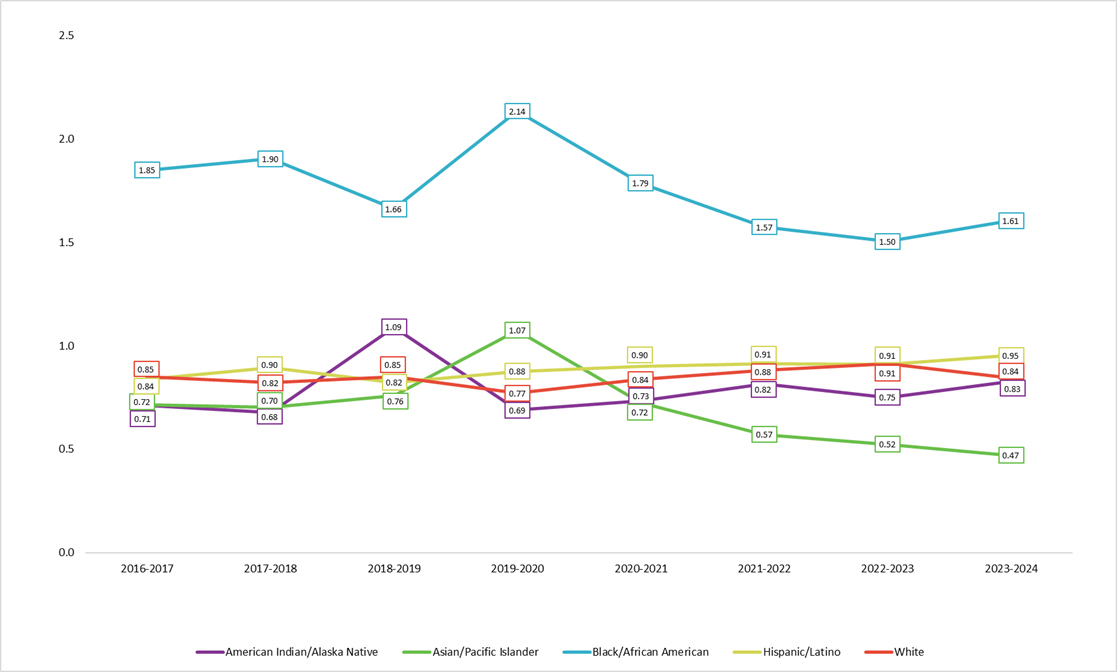
    From 2016 to 2024, subsidized child care programs have enrolled between 27 - 42 percent of the income-eligible population of children under 5 years of age in Washington State. Black/African American children have been consistently over-represented, while other groups have, in most years, been slightly under-represented to varying degrees.

    Racial/Ethnic Disproportionality Ratios for Child Care Subsidy Uptake, School Years 2016-2024

      Line graph showing racial/ethnic disproportionality ratios for child care subsidy uptake, school years 2016-2024. The patterns of representation are fairly consistent over the years. In 2016,  Black/African American children were over-represented in subsidy participation, at 1.85 times their presence in the eligible population, and in 2024 they participated at 1.64 times their presence in the population. Both Hispanic/Latino and White children receive subsidy at nearly the same rate that they’re present in the eligible population. In 2016, Hispanic/Latino children participated at 0.84, and White children at 0.85 times their presence in the population. In 2024, Hispanic/Latino children participated at 0.98 and White children at 0.93 times their presence in the population. American Indian/Alaska Native children are slightly under-represented in subsidy participation. In 2016, American Indian/Alaska Native children participated at 0.71 times their representation in the population, while Asian/Pacific Islander children participated at 0.72 times their representation in the population. In 2024, American Indian/Alaska Native children participated at 0.7 times their representation in the population, while Asian/Pacific Islander children participated at 0.64 times their representation in the population.
     
  • Disproportionality in ECEAP Enrollment

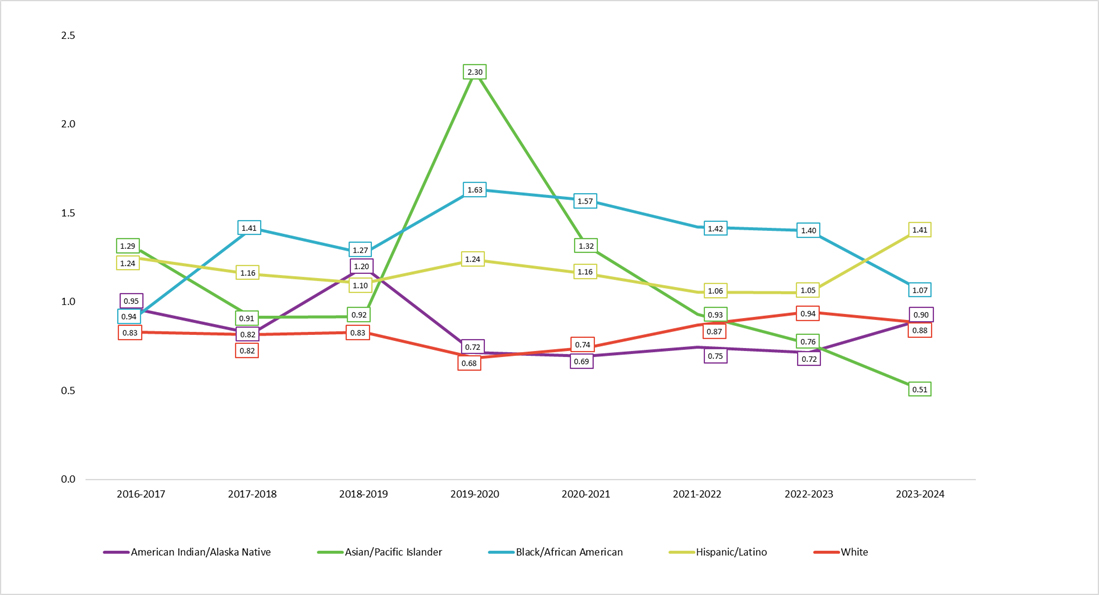
    Each year, around 15,000 children are enrolled in Washington's Early Childhood Education Assistance Program (ECEAP). DCYF tracks disproportionality in ECEAP enrollment using a Disproportionality Ratio. A disproportionality ratio of 1.0 would indicate that children of that race/ethnicity are enrolled in ECEAP at the same rate they exist in the underlying income-eligible population. For the past few years, Black/African American children have been slightly over-represented in ECEAP enrollment, while American Indian/Alaska Native and Asian/Pacific Islander children have been slightly under-represented.

    Racial/Ethnic Disproportionality Ratios for ECEAP Enrollment, School Years 2016-2024

      Line graph showing racial/ethnic disproportionality ratios for ECEAP enrollment, school years 2016-2024. The patterns of representation are fairly consistent over the years. After 2016, when Black/African American children were represented in ECEAP participation at 0.94 times their presence in the eligible population, they have been somewhat over-represented in ECEAP participation. By 2024 they participated in ECEAP at 2.01 times their presence in the eligible population. The representation of other groups has varied a bit each year, but in most years is fairly close to proportionate. In 2016, Hispanic/Latino children participated at 1.24 times their presence in the population, and in 2024 they participated at 0.89 times their population presence. In 2016, White children participated in ECEAP at 0.83 times their presence in the population, and in 2024 they participated at 1.11 times their population presence. In 2016, American Indian/Alaska Native children participated in ECEAP at 0.95 times their representation in the population, and in 2024 they participated at 0.64 times their population presence. In 2016, Asian/Pacific Islander children participated at 1.29 times their representation in the population, and in 2024 Asian/Pacific Islander children participated at 0.71 times their representation in the population.
     
  • Economic Stability

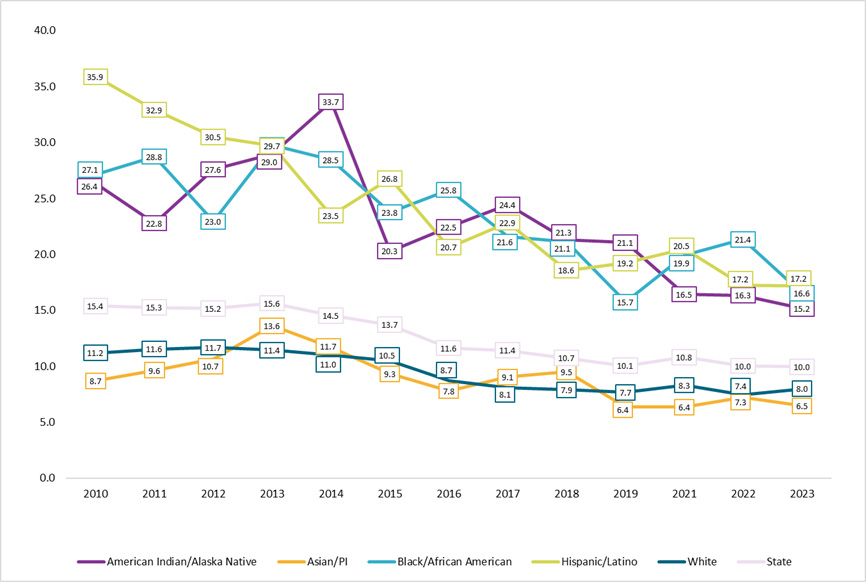
    Another goal of DCYF is that families have economic stability. As DCYF staff engaged stakeholders across the state on what they wanted to see children and families achieve, we heard repeatedly about the importance of basic needs being met. Without economic security, many other positive outcomes related to health and education become harder to achieve. Census data on Washington State families with children living below the poverty level show disparities based on race and ethnicity. While White and Asian families live below the poverty level at rates lower than the state average of 10%, others have much higher rates. American Indian/Alaska Native, Black/African American, and Hispanic/Latino families with children live below the poverty level at rates much higher than what White families experience.

    Percent of Washington State Families with Children, Living Below Poverty Level, by Race/Ethnicity, 2010-2024

      Line graph showing percent of Washington state families with children who were living below 100% of the federal poverty level (FPL), by race/ethnicity, from 2010-2024. During that time, the statewide percent of families living below the FPL has decreased from 15.4% to 9.1%. The percent of families living below the FPL has also decreased for all racial/ethnic groups reported. It has decreased from 8.7% to 4.4% for Asian families, from 11.2% to 7.4% for White families, from 27.1% to 12.6% for Black/African American families, from 26.4% to 16% for American Indian/Alaska Native families, and from 35.9% to 17.3% for Hispanic/Latino families