Child Outcome Goal

  • Youth Suicide Rates

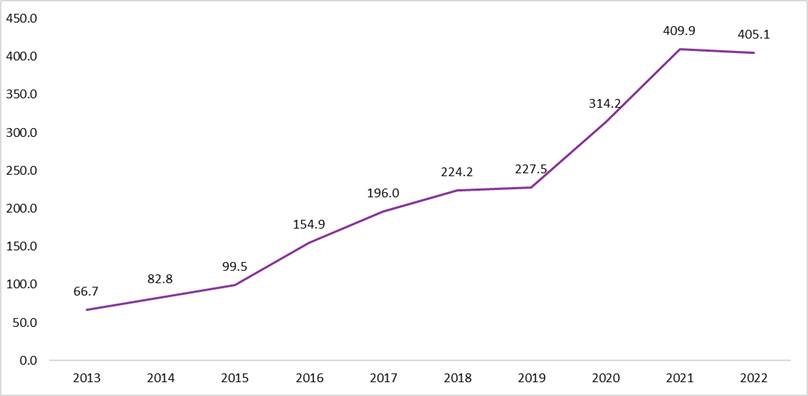
    One of DCYF’s health goals is for youth to experience positive behavioral and mental health. Trends in mental health over the past decade show an increase in rates of suicide and attempted suicide. Although rates began decreasing after 2021, in 2023 the rate of youth suicide and attempted suicide was still nearly 500% higher than it was ten years prior.

    Rate of Suicide and Suicide Attempts per 100,000 Adolescents Age 10-17, 2013-2023

      Line graph showing the Washington state rate of suicide and suicide attempts per 1000,000 adolescents age 10-17 for the years 2013-2023. The rate climbed steadily from 67 per 100,000 adolescents in 2013 to a peak of 414 per 100,000 in 2021. Between 2022 and 2023 the rate of adolescent suicide and suicide attempts decreased to 321 per 100,000

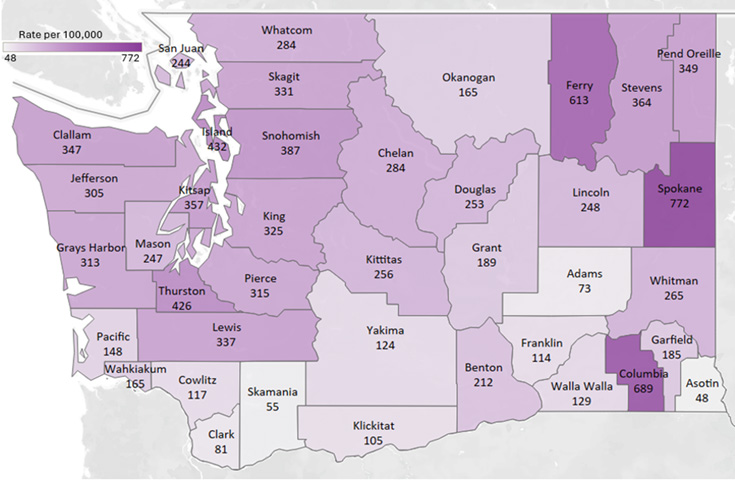
    Suicide and Suicide Attempts per 100,000 Adolescents Age 10-17, 5 Year Rate, 2019-2023

      Map of Washington state showing the 5-year rate of suicide and suicide attempts, per 100,000 adolescents age 10-17, by county, for 2019-2023. Rates ranged from a low of 56 per 100,000 suicides and suicide attempts in Asotin county to a high of 841 in Spokane county. The King county rate was 326, the Pierce county rate was 382, the Snohomish county rate was 360, and Clark county had 88 suicides and suicide attempts per 100,000 adolescents
     
  • Adult Support when Depressed

    In the agency's efforts to improve and support the resilience of children, youth, and families in Washington, DCYF has set a goal that children and youth are supported by healthy relationships with adults. One way to measure this is by tracking the percentage of youth who report having support from adults when they are feeling sad or depressed. Youth who live with their parents/guardians are more likely to report having adult support when sad or depressed than youth who do not live with their parents/guardians.

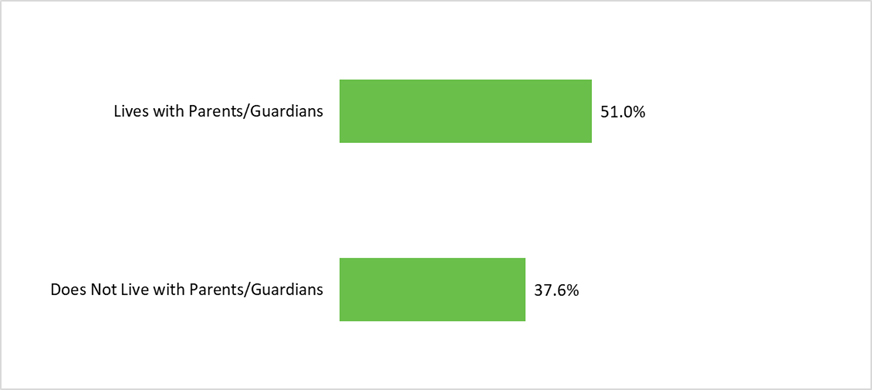
    10th Graders with Adult Support when Depressed, by Living Situation, 2023

      Bar chart showing percent of 10th graders in 2023 who had adult support when they were depressed, by whether they lived with their parents/guardians. That year, when they were depressed, 59.9% of those who lived with their parents/guardians had adult support, while only 47.5% of those who did not live with their parents/guardians had it

  • Youth Depression

    The Healthy Youth Survey asks youth whether, over the past year, they ever felt so sad or hopeless, almost every day for two weeks or more in a row, that they stopped doing some of their usual activities. Results show that youth who live with their parents/guardians are less likely to report having been depressed than youth not living with their parents/guardians.

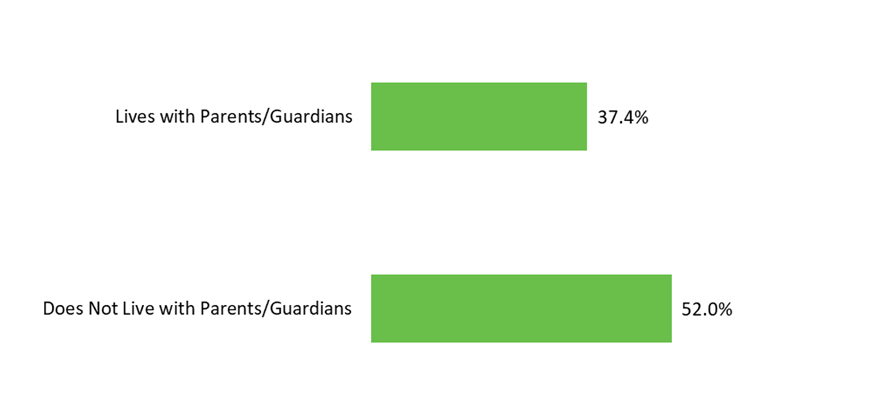
    10th Graders Reporting Depression, by Living Situation, 2023

      Bar chart showing percent of 10th graders in 2023 who had been depressed in the past year, by whether they lived with their parents/guardians. That year, 29.2% of those who lived with their parents/guardians had been depressed, while 47.7% of those who did not live with their parents/guardians had been depressed

  • Well-Child Visits

    Another DCYF health goal is that children and youth reach developmentally appropriate milestones.

    Data from developmental screenings, such as the Early Periodic Screening, Diagnosis, and Treatment (EPSDT) assessment, can be used to track progress on healthy child and youth development; however, this information is not currently available. In State Fiscal Year 2024, 44% of 3 to 11 year olds on Medicaid received at least one well-care visit.

    Percent of 3-11 Year Olds on Medicaid Receiving One or More Well-Care Visit in 2024

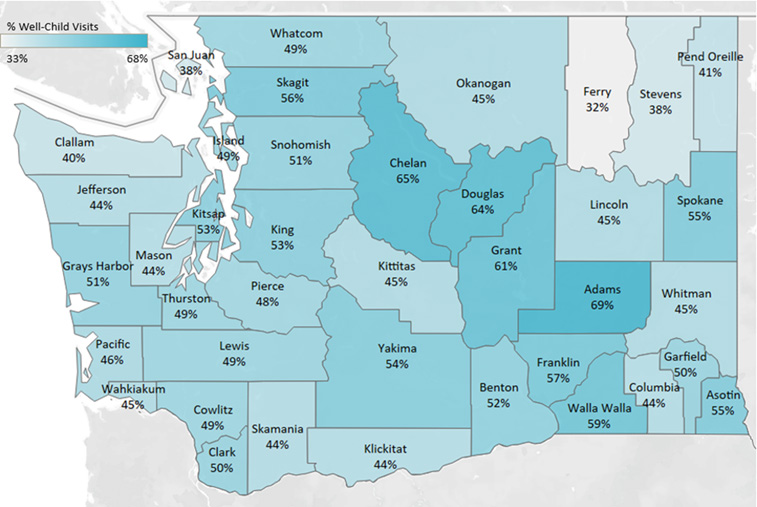
      Map of Washington state showing the percent of 3-11 year olds on Medicaid who received one or more well-care visits, by county, in 2024. Rates ranged from a low of 27% in Ferry county to a high of 63% in Columbia county. The King county rate was 45%, in both Pierce and Snohomish counties the rates were 41%, Clark county had a rate of 37%, and the Spokane county rate was 48%
     
  • Healthy Birthweight

    DCYF’s first health outcome is that more babies will be born at a healthy birthweight. Babies born at a healthy birthweight are more likely to experience appropriate childhood development, both physically and mentally. About 81,000 babies were born in Washington in 2023. Over the past five years, about 68 babies out of every 1,000 live births were born with a low birthweight (less than 2,500 grams, or about 5.5 pounds).

    Babies Born with Low Birthweight, per 1,000 Live Births, 5 Year Rate, 2019-2023

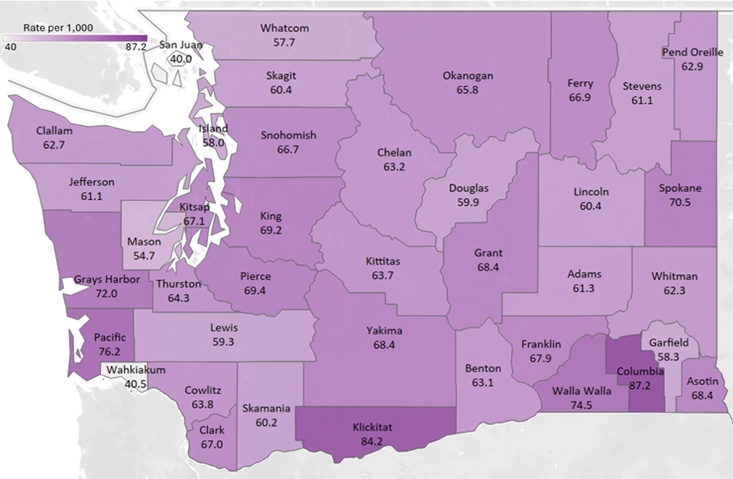
      Map of Washington state showing the 5-year rate of babies born with low birthweight, by county, for 2019-2023. Rates ranged from a low of 22.1 per 1,000 live births in Wahkiakum county to a high of 82.4 in Columbia county. The King county rate was 70.4, the Pierce county rate was 69.5, both Snohomish and Clark counties had a rate of 67.8, and the Spokane county rate was 68.6 per 1,000 live births
     
  • High School Graduation

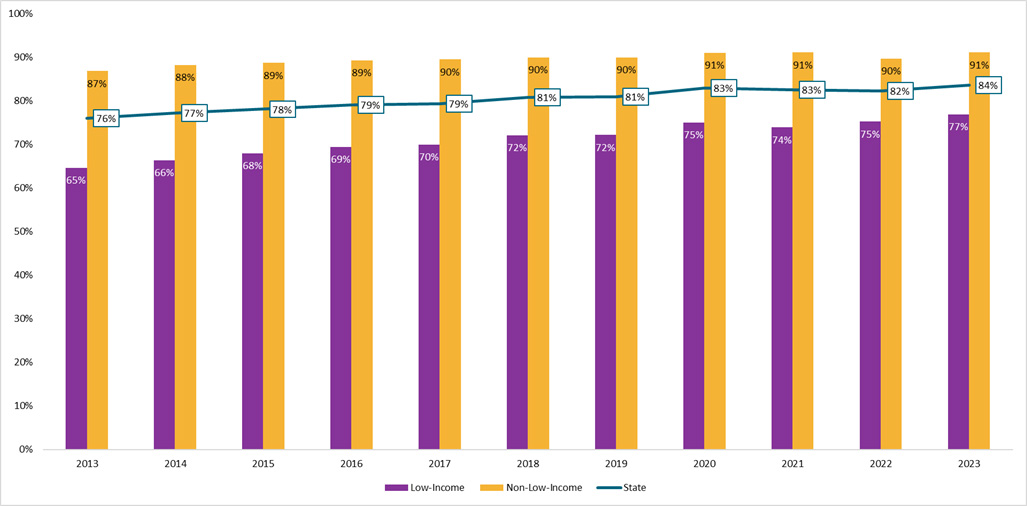
    DCYF’s third outcome goal related to education is that high school students graduate on time. Among 85,306 high school students in the 2023 cohort, 71,329 (84%) graduated on time.

    Among that 2023 cohort, about half (45,070) are indicated as low-income students. Non-low-income students graduated at a rate of 91%. By comparison, 77% of low-income students graduated on time.

    Four Year Graduation Rate, by Income Group, School Years 2013-2023

      Combination clustered column chart and line graph comparing the four-year high school graduation rates of low-income and non-low-income students to the overall state rate, for the school years 2013-2023. Graduation rates for both income groups and the overall state rate have increased over the past ten years. For non-low-income students, the four-year graduation rate has increased from 88% in 2013-2014 to 91% in 2023-2024. For low-income students, the rate has increased from 66% to 76% over those years, while the overall four-year graduation rate rose from 77% to 83%
     
  • Youth School Engagement

    The second DCYF education outcome goal is that youth are engaged in school. Youth who feel more connected or committed to school are more likely to achieve positive academic outcomes and are less likely to experience mental health issues.

    Engagement in school can be measured by the Healthy Youth Survey’s index of engagement in school, which captures information on decision-making opportunities at school, one-on-one opportunities with teachers, opportunities to work on special projects, extracurricular opportunities, and feeling a part of class activities or discussions. Results show that youth who live with their parents/guardians are more likely to report high levels of school engagement than youth not living with their parents/guardians.

    10th Graders with High Levels of School Engagement, by Living Situation, 2023

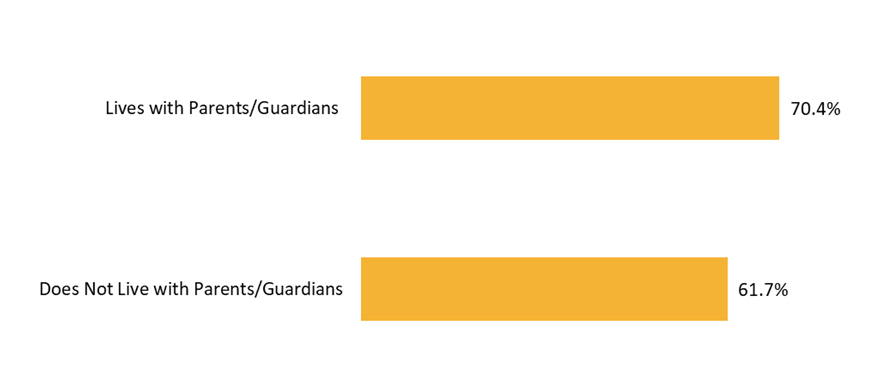
      Bar chart showing percent of 10th graders in 2023 who had high levels of school engagement, by whether they lived with their parents/guardians. That year, 70.9% of those who lived with their parents/guardians had high levels of school engagement, compared to 58.5% of those who did not live with their parents/guardians

  • Kindergarten Readiness

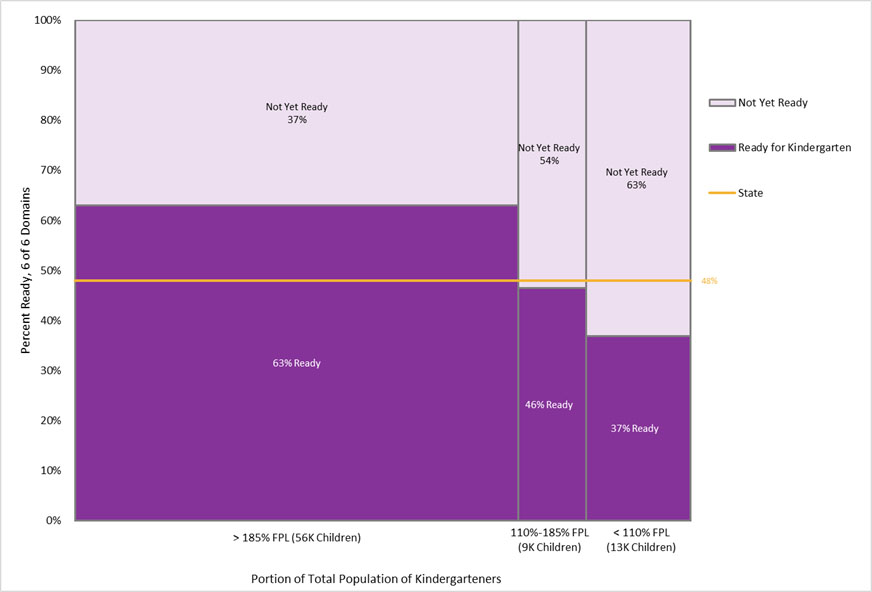
    One of DCYF’s child outcome goals is that children should be ready for kindergarten. Each year over 75,000 children enter kindergarten in Washington’s public school system. Across all income groups, 55% of children in Washington are ready for kindergarten (as measured by the Washington Kindergarten Inventory of Developing Skills assessment). Children from higher income families are most likely to be ready for kindergarten, while children from middle income and lower income families are ready for kindergarten at lower rates.

    Kindergarten Readiness, by Household Income Group (Relative to Federal Poverty Level), 2023-2024 School Year

      Mosaic chart showing kindergarten readiness by household income group, relative to the federal poverty level, for the 2023-2024 school year. Among all children, 55% were ready for kindergarten in 6/6 WAKids domains, but a greater proportion of children from higher income families were ready for kindergarten, while a smaller proportion of children from lower income families were ready for kindergarten. Among the 55,000 children from families greater than 185% of the federal poverty limit (FPL), 69% were ready for kindergarten in 6/6 domains of the WAKids assessment. Among the 1,000 children from families making between 110% and 185% of the FPL, 52% were ready for kindergarten in all 6 of the WAKids domains. And among the 11,000 children from families making under 110% of the FPL, 45% were ready for kindergarten in all 6 WAKids domains
     
  • Economic Stability

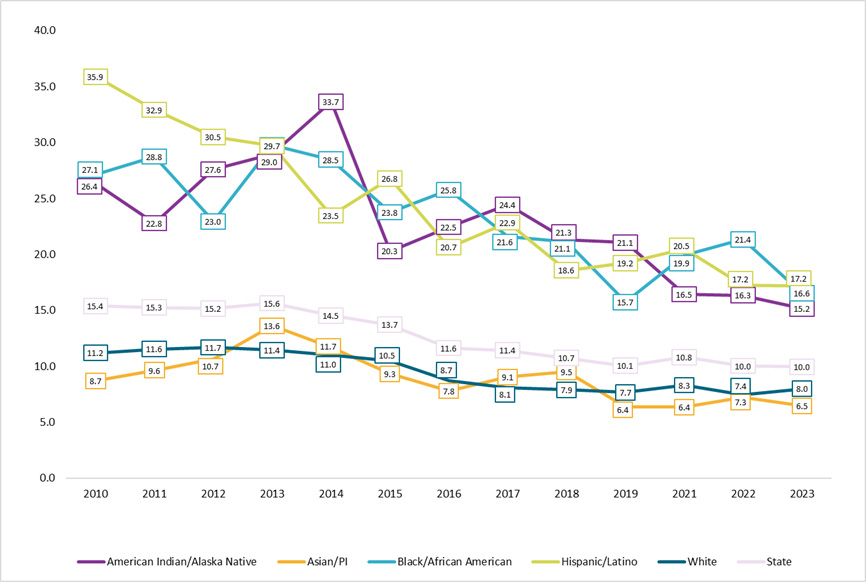
    Another goal of DCYF is that families have economic stability. As DCYF staff engaged stakeholders across the state on what they wanted to see children and families achieve, we heard repeatedly about the importance of basic needs being met. Without economic security, many other positive outcomes related to health and education become harder to achieve. Census data on Washington State families with children living below the poverty level show disparities based on race and ethnicity. While White and Asian families live below the poverty level at rates lower than the state average of 10%, others have much higher rates. American Indian/Alaska Native, Black/African American, and Hispanic/Latino families with children live below the poverty level at rates much higher than what White families experience.

    Percent of Washington State Families with Children, Living Below Poverty Level, by Race/Ethnicity, 2010-2024

      Line graph showing percent of Washington state families with children who were living below 100% of the federal poverty level (FPL), by race/ethnicity, from 2010-2024. During that time, the statewide percent of families living below the FPL has decreased from 15.4% to 9.1%. The percent of families living below the FPL has also decreased for all racial/ethnic groups reported. It has decreased from 8.7% to 4.4% for Asian families, from 11.2% to 7.4% for White families, from 27.1% to 12.6% for Black/African American families, from 26.4% to 16% for American Indian/Alaska Native families, and from 35.9% to 17.3% for Hispanic/Latino families